The Diocese
Posted: 01/29/2021

 This is a book which reflects the faith of the late Catholicos Karekin I, who has been one of the luminous religious leaders of the Armenian Church in the 20th century. His engagement in the international religious arena has been most visible through his active role in the ecumenical circles. The book is a composition of series of questions put forward by Giovanni Guaita, to which His Holiness has responded most eloquently and with a unique richness of the mind and soul.
In his introduction, Giovanni Guaita makes an interesting statement as he refers to the books in the following words: “through this volume, the Catholicos did indeed leave us a ‘spiritual will.’”
“For Karekin I, human life was ‘an encounter between heaven and earth.’ These were the dimensions of his theology and spirituality, their focal point being Christ: ‘God engaged in human history.’ My conversational partner brought this orientation to every problem we discussed. At the same time, he always expressed profoundly Christian point of view, never falling into vague spiritualism or clericalism. Hence, the reader, even a non-believer, can, through the prism of Armenian history and the personal experience of the late Catholicos, find genuine inspiration in the words of Karekin I” (page 20).
I will make an attempt to choose a variety of topics discussed during the interview, which shed light on issues pertaining to our Christian faith life. One has to read the book to get a better understanding of his upbringing, his journey of life and his own philosophy of life, in general.
Speaking about the role of a bishop in the life of the Armenian Church, he shares with the reader the following response in three statements. “To be a bishop, a successor of the apostles, is not a personal choice; it is the answer to a call. He who inherits the mission of Christ must always respond to the call and to He who called him. Second, there is a task to accomplish: the bishop is a messenger, which is what the Greek word apostolos means, apostle; he is sent for a mission, that of continuing the ministry of the Lord among the people who are entrusted to him. Third, a bishop must always feel that he is a servant” (pages 21-22).
His theological perspective on the Eucharist is most inspiring. One can tell that he has a deep understanding of the sacrament. “The Eucharist is the participation in the life of Jesus, and I would like to use a stronger word: it is the reincarnation of God in the life of men. In the liturgical, Eucharistic act, you are not living the presence of God as if it were the commemoration of a historical figure; it is as if He descended once again into the church to join us, as He joined His disciples during His life on Earth” (page 37).
Sainthood is one of his favorite topics. And I have quoted him in many of my sermons. Here he approaches the question in a more elaborate thought: “A saint is not an exceptional person, in the sense that he is not like us, since that would mean that we could not be like him.” He then shares with the reader an expression by Henri Daniel-Rops: “I cannot respect pure and saintly hands that have always been protected by gloves. I prefer hands that have remained pure in mud.”
When he speaks about happiness, Karekin I gives us a comprehensive and truthful answer. “Those who have not lost a sense of the presence of God within them and in their lives are happy.” And I truly feel the same in the depth of my heart. I have surrendered my life into the hands of God and feel spiritually comforted.
Faith is another important aspect in the spirituality of Karekin I. When asked “why do you believe?” he responds with the following words: “I have never asked myself that question because I feel that I believe and I could not not believe; simply put, my faith was born in me during my childhood, and over time, it has become even deeper, more integrated into the framework of my life. To ask me that question, then would be like asking why I exist. The presence of faith is such an existential fact for me that I cannot give you an answer that is purely logical or by reasoning intellectually. Faith is a gift of God, something inherent to my existence. It’s a question of life, and not of reason or of conviction, which is why I don’t really know how to answer that question!” (page 76).
Through his writings, Karekin I cherishes the thought of Metanoia, change in one's way of life resulting from penitence or spiritual conversion. “I think today our nation needs a metanoia, an interior conversion.” I would have wished and prayed that all people would feel the hunger of “interior conversion,” for then this world would have been a better place to live.
As he speaks about the mission of the Armenian Church, he prioritizes the following three points: “Our top priority right now is to reinvigorate the service of the Church by encouraging the formation of new generation of dedicated priests and lay people. Next to that, the second thing that has been the creation of a Center of Christian Education for lay people, which must produce teachers of religion for schools. And third concern involves the cultural service in which the Church must engage itself, since in Armenia you cannot separate culture and religion” (page 113).
Serving people has been his vision. To better express his thoughts, he quotes the following statement from Abbe Pierre: “When you put your hand in the hand of someone in need, you find in his hand the hand of God.”
Many people question the validity of science in the context of religion. I personally do not see any contraction and above all agree with him when he states that “science will allow us to find the feeling that we are not the masters of creation.”
Speaking about the divorce in modern society, he first explains the stance of the Armenian Church and then makes the following statement: “I do not believe in the idea of a ‘temporary family.’ That would be making the family a kind of merchandise, denying the very idea of family, which is an integral part of God’s creation.”
Speaking of human life, he shares with the reader the following thought: “Human life has a sacred character that must be respected.”
And truly, humankind is abusing God’s most precious gift of life. With the same thought he expects from people to respect the nature: “God entrusted the world He created to man, who through science and technology may use natural resources, but he must not waste them.”
Identity is another important aspect of human life. Globalization has been misunderstood by many. We should never ignore “the sense of a national identity. Human beings are not born from nothing.” He then quotes Edouard Balladur: “France is not nature’s creation; it is history’s creation.”
Speaking of “aspect of Christian life,” Karekin I defines ecumenism in these following distinct statements: “I think that ecumenism must consider at the same time three aspects of Christian life: Koinonia, the aspect of spiritual communion; Kerygma, preaching, and Diakonia, service.”
Suffering has been an inseparable infusion in our spirituality. Karekin I gives us a powerful description of the notion as reflected in the lamentations of Saint Gregory. No further interpretation is needed here. “The Elegies, or Lamentations, of Saint Gregory of Narek are rather different from the Book of Job. In these elegies, there is a very profound interior drama, the drama of all men. Saint Gregory represented the spiritual struggle of a man who feels that he has the infinity and all-powerfulness of God and, at the same time, sees the human pettiness that leads him to sin. It is the conflict between the desire to elevate yourself toward God, to participate in His grace, and our condition of fragility; the interior turmoil between the taste for the divine, or the aspiration toward God, and the seduction of sin, or the attraction of the Earth. Finally, that inner struggle becomes prayer.” (page 210).
The theology of the Cross has been a core aspect in the writings of Karekin I: “The crucifixion is the evidence of God’s kenosis. God made Himself man and suffered, that is the greatness of Christianity.”
Here, I would like to share two very empowering thoughts by Karekin I; one is about change and the second about history: “The world changes. Change is not new. The world has always known change and it will continue to change. We are ourselves carried along with these changes. We are not the objects but the subjects, not the victims but the actors.” (page 220).
“History is not something that is acquired, something static. History, human life, is a movement, a process of change, I would say, a process of growth. We are the makers of history, not only spectators.” (page 221).
Christianity is not a philosophy. It is a way of life. Speaking of Christianity, Karekin I makes the following statement: “Christianity is a book that is still being written.”
This book entitled “Between Heaven and Earth” is a powerful guide for all to focus our prayers during the journey of lent on the dignity of human life. Being created in the image of the Creator, the Almighty God, we ought to uplift our hearts with the living message of divine love: “God is love…without end…”
I highly recommend the reading of this book “Between Heaven and Earth.” As we read the words and messages of Karekin I, we then feel in the depth of our hearts the spiritual transformation, a noble feeling which gives birth to the new person in God.
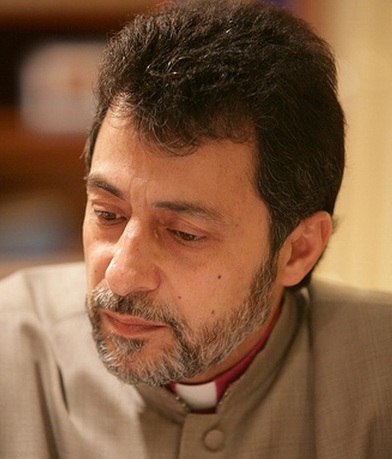
Archbishop Hovnan Derderian
Primate
January 20, 2021